

Iran Is Coming Back Online. Help Keep It There.


After a year of shutdowns, Lantern is working across Iran again, and people are coming back fast. Here is what that means, and how you can help keep them online.
"Perhaps you're not fully aware of the impact you have on our lives. Many of us earn our livelihood through the internet, gain education, and connect with loved ones we miss dearly. You help us survive day by day." - Single mother, Iran
On September 1, about 32,000 people in Iran used Lantern each day. By October 27, more than 275,000 did: nearly eight times as many in under two months.
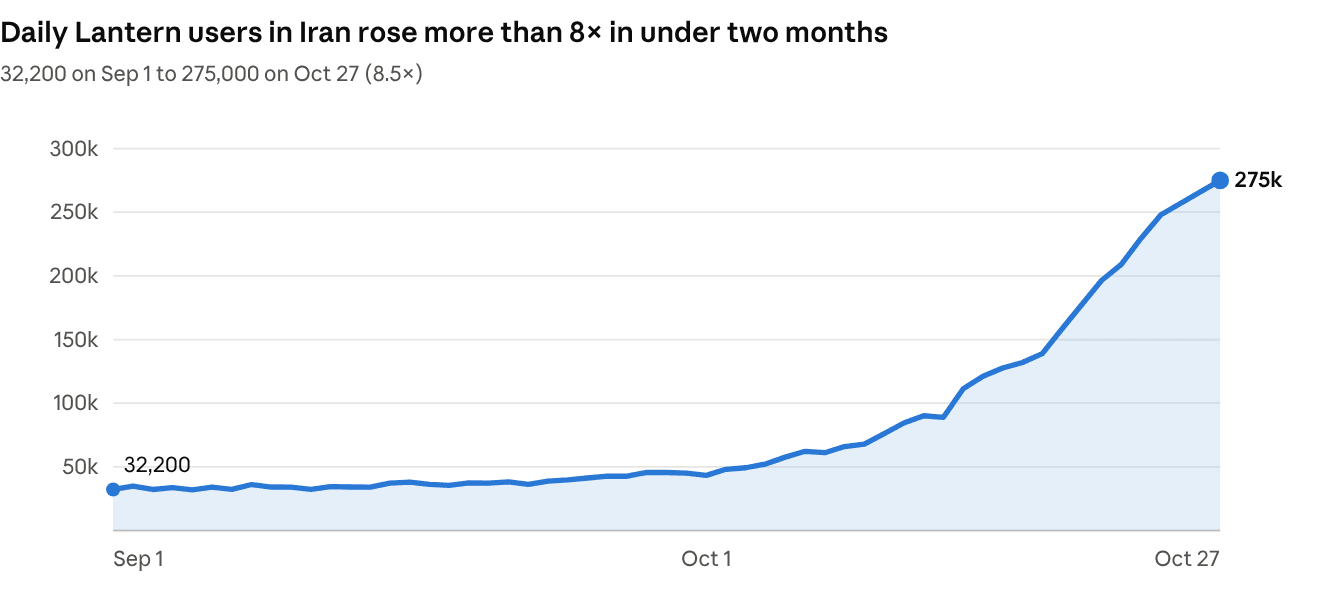
Most people in Iran can't reach the open internet without a tool like Lantern, and most can't pay for one. That's why Lantern is free there, and always has been. Your support keeps it that way.
Our ask: give to keep Lantern free for people in Iran. $10 a month keeps about 90 people online. Give at lantern.io/donate
Why now
Iran spent much of 2026 offline. The longest nationwide shutdown on record began January 8, and a second hit on February 28. At its worst, traffic fell to about 1% of normal.
Access returned in late May, but not the open internet. Iran moved to a tiered system: pre-approved sites for most people, fuller access for a favored few. For everyone else, a circumvention tool is the difference between the state's version of the internet and the real one.
Now Lantern is climbing fast in Iran. After months of engineering work, recent versions connect on a much wider range of Iranian networks, and people who couldn't connect for years are coming back. One user told us: "After three years, I downloaded Lantern again ... It's honestly working really well, better than any other VPN I have." Iranian digital rights groups and independent media are helping spread the word.
We've been here before. During the 2022 Women, Life, Freedom protests, more than 10 million people in Iran used Lantern each month, and at its peak Lantern carried up to 13% of the country's internet traffic. We've been doing this since 2010.
How Lantern keeps people connected
A typical VPN runs a few standard connection types on a fixed set of servers. In Iran, censors recognize those connection types and block known servers quickly. Lantern runs many ways of connecting at once, disguises them as ordinary web traffic, and replaces servers as they're blocked.
The censorship keeps getting more advanced. Iran is building its system on the model of China's Great Firewall, with China's help. Chinese companies have supplied equipment for Iran's filtering since at least 2010, and this year officials said they imported Chinese equipment to make the new restrictions permanent. A tool that stays the same eventually stops working, so Lantern keeps changing:
- When censors block one way of connecting, we can send users a new one within hours, without an app update.
- Each person is routed through whatever is working on their network that day.
- Some of Lantern's connection methods are designed and tested by AI systems against the censor's current behavior.
- When our servers are blocked, users' devices can help each other find a way through.
For the technically curious
- Protocols. Hysteria2 and TUIC (built on QUIC for lossy, high-latency connections), and VLESS, plus obfuscation layers like AnyTLS and ShadowTLS that make VPN traffic look like ordinary web browsing to deep packet inspection.
- WATER (WebAssembly Transport Executables Runtime). We ship new transport protocols from the server side, so a fix reaches users in hours rather than after an app-store review.
- AI-generated protocols. Samizdat and Reflex are running in production.
- Per-user routing. A machine-learning system assigns each user the routes that are working on their network that day.
- CounterPunch. Users' devices share connection details with each other when central servers are blocked.
Our code is open source on GitHub.
Coming soon: a connection from someone you trust
Our next step turns Iran's diaspora into a lifeline. With Invites, anyone in Iran will be able to ask a friend or relative abroad to be their private connection to the open internet.
- Someone in Iran invites a friend or relative outside the country.
- The friend accepts and becomes their personal bridge.
- Traffic runs through that one person's home connection. No public list holds the address, so there is nothing for the censor to block.
Public servers end up on blocklists. A private invite route doesn't. And every invite is a person outside Iran hearing about Lantern from someone they love.
What it takes to keep one person online
Keeping someone in Iran connected costs Lantern about 11¢ a month. That means $10 a month keeps about 90 people online, and every new person who connects adds to what it takes to keep them there. Your gift pays for the servers and bandwidth they use, the engineering each new block demands, and the capacity to scale up the moment censorship tightens.
We work hard to make every dollar go further:
- We keep cutting what each connection costs. Since September, our cost per gigabyte has fallen about 85%, and the cost per person dropped from about 20¢ to about 11¢ a month, while the number of people grew nearly eightfold.
- A small team. Lantern serves more than a million users a month with a team of fewer than 20.
- Paying users help fund free ones. Lantern Pro subscriptions from people in open countries help cover free access for people in places like Iran.
- Free distribution. In Iran, Lantern spreads through Iranian digital rights groups, independent media and word of mouth, so our spending there goes to keeping people connected.
- Volunteers carry traffic. With Action Mode, people in uncensored countries share their own connection with people in censored ones.
- Open source. Our code and findings are shared with other circumvention tools, so one discovery protects more people than ours.
Help keep Iran connected
The technology is working. People are connecting. Help us keep it that way.
- Give. Donate at lantern.io/donate, or give monthly. Gifts are tax-deductible.
- Give stock, crypto or through a donor-advised fund. Email [email protected] and we'll help.
- Share your connection. Turn on Action Mode and lend your bandwidth to someone who is blocked. It takes a minute.
- Be someone's connection. When Private Proxy launches, say yes when a friend or relative in Iran asks you to be their bridge.
- Share this post. Send it to one person who cares about Iran or an open internet.
Lantern is built by Brave New Software Project, Inc., a U.S. 501(c)(3) nonprofit (EIN 27-3272909), and has kept people online since 2010. Gifts are tax-deductible to the extent allowed by law. Press and major gifts: [email protected]